February 22, 2016

ST-BARTHELEMY & ILE FOURCHUE

A St-Valentine’s Massacre:

Our 11 hour sail between Barbuda and St-Barthelemy (St-Bart’s) was one we’ll never forget.  We caught a 25 pound Mahi (so we think) and did our usual by pouring fish gin down it’s gills to sedate it or perhaps even kill it prior to bringing it on board, in our cockpit.    Normally, I put all pillows, seats and anything that could get dirty or get in the way, down below before bringing fish on board.  For some reason, this time I didn’t.   There was a little amount of blood which isn’t a big deal.

Our fish, we named “Freddy” came back to life.  He was a zombie !!!!  Unlike the slow moving Walking Dead people, Freddy was thrashing wildly in the cockpit splashing huge amounts of blood everywhere.  I mean everywhere; the inside of the bimini, all over us, on our seats, under covers, down below, places you wouldn’t even imagine how the blood got there.  Tim had to hold it down so it would stop.  I sat back and laughed.  What else was I going to do?  It looked like we slaughtered a cow.

Now, reality set in.  We were not happy at all.  While going downwind at 7 knots rolling back and forth with our whisker pole keeping our jib out, we had to clean up the mess and scrub all the blood.  We bagged Freddy and threw him in the freezer. 
Once anchored in beautiful Anse De Colombier in St-Barts and 11 hours later, I still needed to fillet Freddy and clean everything again but this time with fresh water.  We ended up having a delicious Mahi dinner with wine to celebrate the end of our day.

I did not take any pictures of our St-Valentine’s massacre because my feet were covered in blood and my camera was down below and besides, it was quite gruesome and not everyone would have appreciated the picture.

The following day we hiked from Anse De Colombier to Anse Flamands, walked down the beach to find beautiful French hotels then took the road to a view point where we could see Anse Flamands and Anse De Colombier.  We continued walking of the road admiring the upscale homes and hiked back to the beach taking a trail.  Along the way, we fed a friendly land turtle, saw green lizards, and sheep. 

LEFT:  ANSE DE COLOMBIER WHERE ALPENGLOW IS ANCHORED.  RIGHT: ANSE FLAMANDS

WE HAVEN'T SEEN WHALES SINCE THE DOMINICAN REPUBLIC.   

BEAUTIFUL ANSE FLAMANDS

ANSE DE COLOMBIER.  ALPENGLOW IS IN THE FRONT

WE GOT LEAVES FROM ABOVE WHERE THE TURTLE COULDN'T REACH

 
ART ON THE OUTSIDE OF SOMEONE'S HOUSE

We walked from the main town, Gustavier to the St-Jean roundabout to watch the planes land.  Pilots have to have special training to land at this airport because they have to fly between a very narrow area then nosedive onto the runway.  We stood on the road prior to the plane nose diving.  They were so close, it seemed like they could have hit us. 

TIM IS SITTING ON THE FENCE IN A BLUE SHIRT

This was our second time in St-Barts.  Too view my previous blog on St-Barts, look for it dated April 1, 2015.


From Anse De Colombier to Ile Fourchue is only a few nautical miles.  This island is uninhabited with no beach per say.  The water here is not clear.  So why go here you ask…The hiking !!  it has several peaks with stunning views.  There is some scrambling involved and some route finding but lots of fun.  We bagged the 3 tallest peaks on Ile Fourchue in less than a day having lunch on the tallest peak, about 1,000 feet. 

These peaks are not very tall for us since we are big hikers back home in Colorado, however, don’t be fooled.  They have their challenges.  Heat, humidity, no designated trails, prickly bushes, spiders, slippery rock, and crumbling rock and perhaps snakes to contend with.  The heat sucks out my energy so I’m always wearing a hat and looking for shade.

VIEW OF ILE FOURCHUE FROM THE HIGHEST POINT

CENTURY PLANTS


INFORMATION FOR CRUISERS:
At Ile Fourchue, as of Feb.17, 2016, the mooring ball closest to the beach is half way chaffed thru.  Use your second line under the knot.

Anse De Colombier is very beautiful with a nice beach.  There are no facilities in Colombier.  It’s a long dinghy ride to Gustavier to clear in and out however in calm seas it’s quite doable if you have a reasonable outboard.


February 11, 2016

BARBUDA

We had a good sail however a bit rough from Antigua to Barbuda.  We landed a King Mackerel which was big enough for 5 meals.  As we were pulling in the fish, some shark bit the tail off.  Good thing it didn’t get the whole thing!

KING MACKEREL (WITHOUT TAIL)

Barbuda is a low island whose highest point is 125 feet above sea level.  There are about 1800 inhabitants.  The island is over half the size of Antigua.  There are endless pink beaches, one being 11 miles long.  Ashore, donkeys and horses roam wild. 

The Barbudan people were originally imported as slaves by the Codrington family who leased the island from England, beginning in 1685 for one fat sheep.  The Codringtons used it mainly for growing livestock and root crops for their estates in Antigua and as a hunting ground for the Codingtons.  Consequently, the Barbudans were not closely supervised and retained a tough independent spirit.  When emancipation came, they stayed on the island, living in a cooperative way.  Land is held communally and there is so much that no one fights over it.  It has been the key to the Barbudans keeping control over their own island.    Since there is no individual land ownership, land cannot be sold to outsiders.  Many Barbudans see no benefit to changing their traditional life-style for one of being dressed up and employed to wait on tourists in exchange for the dubious benefits of better roads, more cards, and Kentucky Fried Chicken.
Today, the main settlement is called none other than Codrington. 

We toured the Frigate Bird Sanctuary with George who is on the front cover of Chris Doyle’s Cruiser’s Guide, 13th Edition.  George grew up on Barbuda and loves showing people his Island.  The Frigate sanctuary is a protected area and can only be visited with a guide and rightly so.  It is a magical place with thousands of Frigates.  This colony of birds was featured in National Geographic magazine. 

US WITH GEORGE

GEORGE ON CHRIS DOYLE'S FRONT COVER 

Here is some information about Frigates:  Frigate birds may live for 40 years.  They have 1 egg every season (once a year).  The male stays with the newly born bird for about 4-5 months.  At that time the young birds can start flying and the female takes over caring for their young.  Female birds have white breasted feathers.  Male birds are all black.  Male birds try and attract a mate by blowing up their red pouch on their chest.  Frigates have a wing span of about 6 feet although they only weight about 2-3 pounds.  They have the greatest wing area in proportion to their weight of any bird.  This comes at the cost of being ungainly on their legs and they are unable to take off if they become submerged, therefore, they avoid landing in the sea. They eat flying fish mostly.   They can stay in the air for days at a time. 

I saw a baby out of its nest and without hesitation, George went into the water and gently took the bird and placed it back on the nest.

THE WHITE BIRDS ARE BABY FRIGATES

MALE FRIGATES TRYING TO ATTRACT A FEMALE (LUCKY FOR US, IT WAS MATING SEASON)
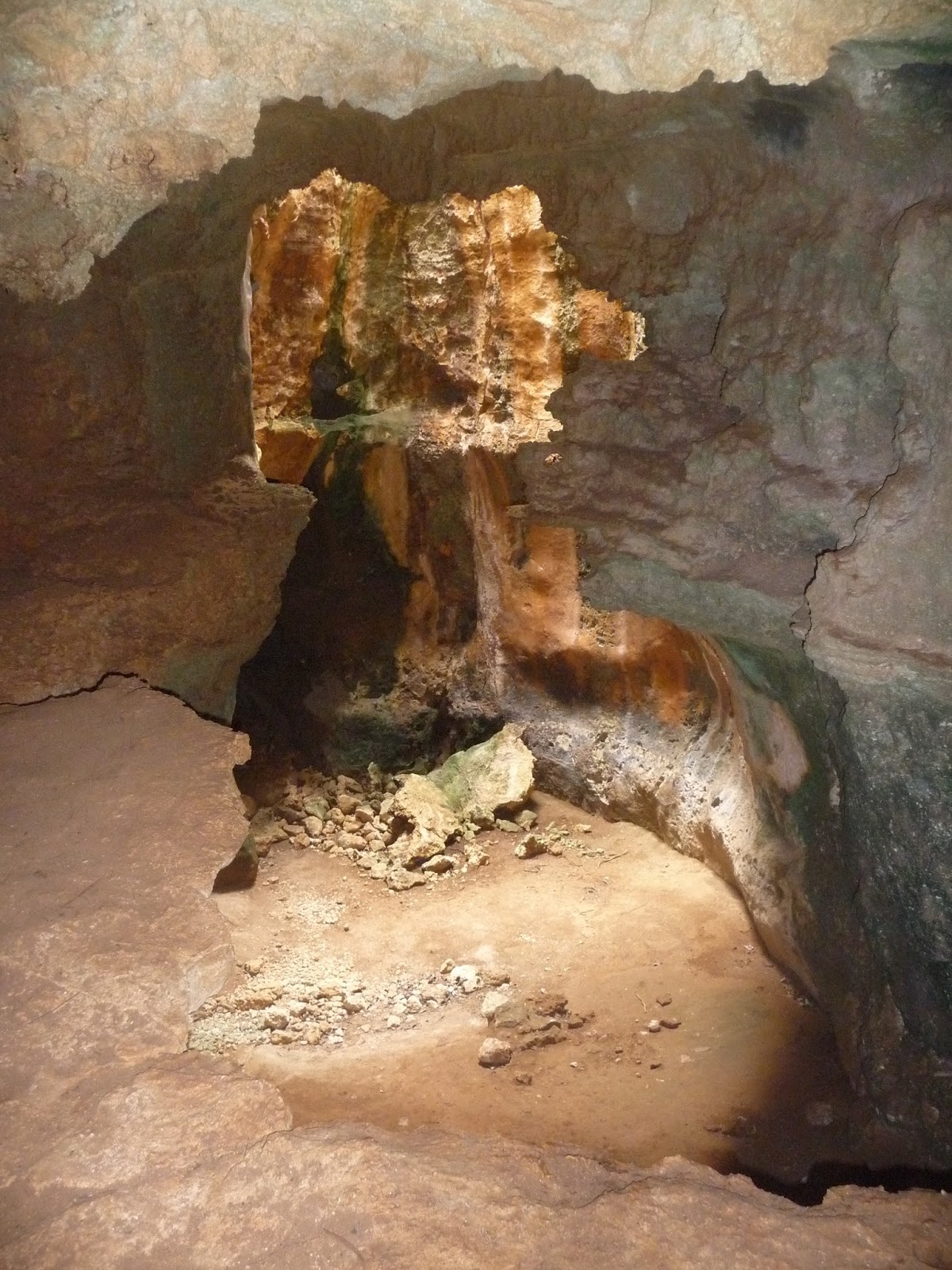
 We then visited the Darby caves:
DARBY CAVE

PETROGLYPHS INSIDE THE DARBY CAVE

COCOA POINT BEACH, WHERE WE ANCHORED FOR A FEW DAYS (Notice, nobody's on the beach)

There were big swells from the north coming into the anchorage making it just a little uncomfortable.  So, we moved to Spanish Point anchorage which was far more protected by the numerous reefs.   You could hear the loud roars of waves crashing over the reefs all day and all night long.

WINDWARD SIDE WHERE WAVES WERE CRASHING ON REEFS
Here, the water is the clearest we’ve seen since the Bahamas.  There are numerous reefs and many healthy, so I wonder why there wasn’t many reef fish?  No worries, we saw a basketball size octopus that seemed to want to hide into a conch shell however, it was way too big for that shell.  As we kept snorkeling, I saw lots of sand being stirred up clouding my view.  I knew something was going on so I swam towards the cloud to see a huge eagle ray stirring up the sand to bury itself.

We went on a long hike to find an old sand mine.  Wild donkeys and horses drink fresh water from the old sand pits.  Here, we found many donkey and horse bones.


February 7, 2016

ANTIGUA

Antigua states that they have 365 beaches, one for every day of the year.  From a yachties perspective, Antigua has more beautiful, protected anchorages than most other islands.  Antigua is famous for their Sailing racing week in April of each year. 

English Harbor:  From the Galleon beach, we hiked the Lookout Trail to Shirley Heights for sunset.  Shirley Heights is named after Governor General Shirley.  It has spectacular views of English and Falmouth harbors.  Today, it’s a bar and restaurant with great steel and reggae bands.


Nelson’s DockYard at Falmouth Harbor:  In 1745, work begun on the dockyard.   Nelson took over as naval commander after Sir Richard Hughes, blinded himself in one eye while chasing a cockroach with a fork.  Today, both English Harbor and Falmouth Harbor are managed by the Nelson’s Dockyard National Park.  This is not only the yachting capital of Antigua but also a major Caribbean yachting center.  It has a fantastic free museum and many old restored buildings to visit.  From here, we hiked to the point and also to Pigeon beach.


Following the Battle of Trafalgar in 1805, rum acquired the nickname “Nelson’s Blood” because sailors believed that Nelson’s body had been placed in a casket of rum to preserve his body on the trip back to England.  Nelson’s body had actually been placed in a cask of French Brandy with camphor and myrrh.  Nevertheless, rum retained its moniker as “Nelson’s Blood” and served as the inspiration for several sailors’ hymns.

These pillars were once part of a sail loft.   On top of the pillars was a roof.  Boats would come into the waterway, unload their sails and placed above so men could work on the sails.

Figure Heads are wooden decorations found at the prow of ships.  The traditional view for centuries was that women had no place at sea.  The only woman happily accepted on board by many sailors was the ship’s Figurehead.  Despite of women being viewed as unlucky aboard a ship, women were perversely viewed as the best navigators and the eyes of the female figurehead were thought to be able to find a way through the seas when lost.    Many female figureheads were bare-breasted as it was thought bare breasts would shame a stormy sea into calm. 


Ships Biscuits:  At the time, sailors ate many biscuits, officially called bread, was also called Hardtack.  It was very hard at first but as a voyage went on it became soft and crumby, partly due to the weevils that ate it and lived within it.  It was customary to tap the biscuit hard to stun the weevils before eating. 

This rowboat crossed the Atlantic ocean

Jolly Harbor:  We went to Jolly Harbor to meet up with cruiser friends of ours that we hadn’t seen in about a year (Krista,Phil,Brenda & Al).  We also met up with Melissa & Dan who we didn’t see since last spring in Guadeloupe. 


 CELEBRATING AL'S BIRTHDAY (NOTICE AL & PHIL SMOKING CUBAN CIGARS)

JOLLY BAY

AL'S BIRTHDAY PRESENTS.  CUBAN CIGARS AND COCK SOUP MIX, HA HA HA

Biking with new friends Janice and Dave on s/v Livin’ Life who are headed south to Grenada for the summer as many of our friends will be during hurricane season.  We had hoped they would follow us to Bonaire but that’s for another time. 


Six of us rented a car and toured the island.  We drove up Fig Tree Drive and visited the Wallings reservoir.  There are a couple of hiking trails there with signs that describe the trees. 


Devil’s Bridge is a beautiful natural rock bridge over water with a blow hole nearby
Harmony Hall is a beautiful restaurant with an exquisite art gallery.  At one of the bars, you can pour yourself a shot of rum for free, in fact, nobody was there….we could of drank the whole bottle !

HARMONY HALL
ART AT HARMONY HALL


The bananaquit is a species of passerine bird of uncertain relation. It is tentatively placed in the tanager family, but classified as incertae sedis by other authorities such as the American Ornithologists' Union


We enjoyed learning about donkeys and brushing them at the Donkey Sanctuary
Deep Bay  is a charming, uncrowded anchorage with a nice long beach and minimal people ashore.  We snorkeled on the wreck of the Andes.  This three-masted iron barque was sailing from Trinidad with a load of pitch in 1905.  When it got to Antigua, the crew noticed smoke rising from one of the hollow masts and suspected the motion of the boat had caused enough friction in the cargo to start a fire.  Having hazardous cargo, they were refused permission to go into St-John’s (capitol), so they anchored in Deep Bay.  When they opened the cargo hatches to deal with the problem, the infusion of the fresh air caused the pitch to burst into uncontrollable flames.  It is now encrusted with sponges and coral and provides shelter for big schools of small fish.  It was worth snorkeling on this wreck.
We hiked to  Fort Barrington that has commanding views all around.  It was a battery and observation post from Nelson’s time.  


FROM LEFT TO RIGHT: VIEW OF ST-JOHN'S, SALT BAY & DEEP BAY

Great Bird Island and other outer Islands, namely Rabbit, Lobster, Readhead and Exchange Islands are all protected from the east by a series of reefs, barrier islands and rocks.  The shapes of the rocks provide drama to the view and one of them, Hell’s Gate, has a hole right through it. Great Bird Island has two, 100 feet blow holes that fall right into the sea.  This is a wild, uninhabited area, I call paradise.  There are very few boats and a couple of nice small beaches.  There are many Red Billed Tropic Birds that have long white tails.  It is the only home of what might be the rarest and most endangered snake in the world, the Antigua racer (Alsophis antiguae).

THERE WERE NUMEROUS RED BILLED TROPIC BIRDS AT GREAT BIRD ISLAND (thx wiki for the picture)

GREAT BIRD ISLAND

BONES OF BIRDS

LUNCH SPOT ON GREAT BIRD ISLAND (PART OF ANTIGUA)

ONE OF TWO BEACHES ON GREAT BIRD ISLAND

Next to Great Bird Island is Hell’s Gate Island with a most beautiful arch.  I’m glad we were rock climbers because it took some moves to get on top.  Unfortunately a big piece of rock broke off and landed on Tim’s leg and toe.  He only sustained a few scratches, phew.  Because of that, we decided that it wasn’t a good idea to walk on the arch.


HELL'S GATE


OUR DINK ANCHORED AT HELL'S GATE

NOT SURE WHAT THESE CREATURES ARE, TIM SAYS THEY ARE ALIVE !

IT WAS POSSIBLE TO SWIM FROM OUR DINGHY TO HELL'S GATE

VIEW FROM HELL'S GATE.  OUR ANCHORAGE IN THE BACKGROUND

Long Island, Jumby Bay, is a small resort island with villas and a few private homes.  All resorts are exclusive and very high end.  A security guard stopped us before we got to a private home.  Gomez told us that 1 night’s stay in a villa is about $5000.00 US.  He said if we wanted to we could reserve a table for diner.  He said it would cost us about $500.00.  OK then, sure, on a cruiser’s budget, we can afford that, ha ha ha.

We returned to Jolly Harbor for four main reasons:  1. Laundry 2. Grocery shopping  3. Superbowl  4. Clear out to go to Barbuda.  I managed to get 20 cruisers together and reserve front row seats at the Crow’s Nest Bar & Restaurant to watch the Superbowl game.  They have a projector and large screen.  Go Broncos !  I'll never look at football the same way again.  Krista kept seeing the players do ballerina moves, thanks Krista !

Shell Beach Boatyard at the airport is worth mentioning.  This facility is used by super yacht owners arriving by private jet.  This boatyard is only a few hundred feet from the airport.  There is an exclusive facility for looking after private jets.  They park nearby, the crew and passengers do not go anywhere near the main airport.  Customs and immigration are done in privacy at the plane or in the ‘special’ office.  The crew and luggage drop them off at their waiting tender at the marina.  GADS !  Can’t these people do anything on their own?

Next blog:  Barbuda.

January 6, 2016

GUADELOUPE

We sailed from St-Pierre, Martinique to the Island of Marie Galante off the mainland of Guadeloupe, taking us exactly 12 hours.  If it wasn’t for the several squalls, we would have had a fantastic sail.  The squalls screwed up the wind strength and direction.  Along with the current, we had a hard time making it to Grand Bourg Harbor thus we had to use our motor. 

We visited this island mostly by car.  It’s a small island so in a day, we drove all around the island and visited some sites along the way.  Our first stop was the Domaine de Bellevue Rum distillery.  It was kind of early in the morning but yet we couldn’t help but stop by the tasting counter and purchase some Rum agricole. 


NOTICE THE 59% ALCOHOL CONTENT


Anse Canot has a beautiful, mostly private anchorage with a nice beach.  It was one of the beaches without sargassum seaweed.  This seaweed was particularly thick around Marie Galante unfortunately.  It stinks but mostly it’s a nuisance for fishermen and tourists on beaches. 

My favorite site on Marie Galante is a natural round sinkhole with a 200 foot high rim and an arch at the bottom open to the sea.  It is named ‘Gueule Grand Gouffre’.

Gueule Grand Gouffre


We stopped by the town of Capesterre.  It was run down and had much sargassum seaweed so walking along the seashore wasn’t pleasant due to the smell.  Hopefully, the seaweed will subside soon.  The town of Saint-Louis was also run down.  Marie Galante used to produce much agriculture and sold their produce on the mainline.  Nowadays, it’s a sleepy island in which tourists come by ferry from the mainland to visit for a day. 

SARGASSUM WEED


We had a fun sail from Marie Galante to St-Francois.  We landed a Mahi Mahi and made a fish chowder.  We shared our meal with friends Vince and Ralph as they shared their Wahoo with us a few days prior.  Their Wahoo measure 59 inches.  They were so kind as to give us some of their fish for later.  Thanks Vince & Ralph !

The tiny airport in St-Francois is extremely close to the shore.  All day long, you can see skydivers, gyrocopters and many small handmade planes.  Around the marina are some very nice shops and several restaurant/bars where you can people watch.

At Iles de Gosier we anchored between the island and the mainland.  The island is quite small but very quaint with a working lighthouse and snack bar.  We snorkeled and saw a large octopus which we watched for quite some time.  It slowly swam over rocks and coral and every time it moved, we saw its camouflage change with its environment.  Of course, I did not have my camera with me.

ILES A GOSIER


From Iles de Gosier we dignied 3 miles into Point a Pitre, the major city in Guadeloupe.  The dinghy dock was right across from the fishermen’s market and La Darse fruit and vegetable market. 


We visited the Victor Schoelcher museum.  From 1829 to 1830, he visited slave plantations in the south of the United States and during a stopover in Cuba, he discovered the cruel reality of slavery.  When we returned home, he began his career as an abolitionist writer.  He adhered also to the young French Society for the Abolition of the Slavery.  For almost 20 years, Schoelcher devoted his life and fortune to the abolition of slavery in the French colonies.  He campaigned relentlessly, which contributed to the French decree abolishing slavery on the 27th of April, 1848.

“A two storey limestone building was built for the museum and was inaugurated on July 21st, 1887.  It was one of the first museums to open its doors from France overseas"

We anchored at Iles a Cabrit which is part of Iles Des Saintes.  It is an uninhabited island with over 100 sheeps and goats.  Having sundowners on the beach was difficult as the chickens would peck all around us hoping to get some of our appetizers.  

There are a couple of wonderful hiking trails on the island with views from each side of the island.  Napoleon had built a fort on this island for his wife called Fort Josephine.


ILES DES SAINTES


We anchored in Deshaies only to provision and clear out of the country since we’ve been here before.  See previous blog on Guadeloupe from April 2015.  We did however dinghy over to Pigeon Island to snorkel at one of Jacques Cousteau’s underwater park.

HINTS FOR CRUISERS:
Grand Bourg, Marie Galante:
Anchorage:  There is only room for about 4-5 boats near the docks.  Chris Doyle says you can tie up to the docks for free but there isn’t any room as many local boats are already there along with fishing boats with their fishing lines on the dock.  Don’t count on getting a spot there.  Also, you may need to put a stern line out as it’s a tight anchorage. DO NOT anchor near the ferries.  It is very protected in a northern swell.
Buses:  From Grand Bourg, buses go to Capesterre and St-Louis every 20 minutes in the morning but good luck waiting for one in the afternoon to get back to Grand Bourg.  They have no schedule.  They basically leave St-Louis and Capesterre towards Grand Bourg to make the last ferry.
Customs:  Pass the tourist office until the road curves to the right.  The customs office is the pink building with white doors in the left hand corner before the road curves to the right.  There are no signs at all.  Use the door on the right side of the building.  Ph # is:  0590 97 54 49.  Cel phone # 0690 83 33 10.
Car Rental:  There are several car rentals along the ferry docks.  ~ 35Euros per day.  You can tour the whole island in one day.
Provisioning:  Le Carrefour is one street up from the docks on the right.  They sell ice for 3.50 Euros.
Ice:  Le Carrefour and the gas station.
St-Francois:
Anchorage:  Good and large
Iles de Gosiers:
Laundry:  From the dinghy dock, walk past the park and when you hit the first major street, turn left.  Walk about 3 minutes and the laverie is on the right side.  It has 4, 8kg washers (5 euros) and one 14kg washer (8.50 euros).  The 2 very large dryers are 1 Euro for 10 minutes.
Pointe a Pitre:

Grocery:  It has a Super U and Economax along with several smaller grocery stores.  You may also choose to buy fresh produce and fish at the markets (they close at 14hrs).